Week 11
Our days in Chiang Mai

At no fault of the Thai train line, our overnight ride from Bangkok to Chiang Mai was one of our least restful nights.
We’re unhappy to report that it seems the world over has abandoned the social contract of headphones. (WHY!?!)
Half asleep, we hauled ourselves and our bags off the train and again disappeared into a sea of backpacking backpacks. Following our compatriots out of the station, there was an instant corralling of groups into various songthaews - retrofitted pick-up trucks that operate somewhere between a bus and an Uber pool (a pre-determined route, but you pick your stop from a laminated map of tourist spots), with an attached open door cabin of sorts and two benches across the sides (songthaews is Thai for two benches).
With the set per person fare somehow outnumbering the fare of a Grab (Asian Uber), we opted for the luxury of a private vehicle with doors.
To reach our hostel, we followed the outer north wall and moat (yes moat) of the Old City.
Constructed as the capital of the Kingdom of Lanna (Kingdom of a Million Rice Fields), Chiang Mai was built to withstand military incursions from all sides - four outer walls, surrounded by a moat, further protected by the Ping River to the east and the mountains of Doi Suthep to the west.
The gates built into each wall were the only points of entry, closing each night to further shield the city. When opened each day, the gates would serve as natural market hubs.
The inner ancient city was planned with cosmology - with multiple Buddhist temples purposefully placed across the inner city.
The moat filled with water, remnants of ancient walls and gates still standing, and multiple night markets just outside each gate - the legacy of the ancient city is still palpable some 700+ years later.
Dropping off our bags, it was desperately time for a coffee.
Walking the moat a few blocks, we found a small one-man coffee shop, serving of all things ‘espresso gin orange’ - a fresh squeezed orange juice base, topped with an espresso, topped with a gin and soda mix.
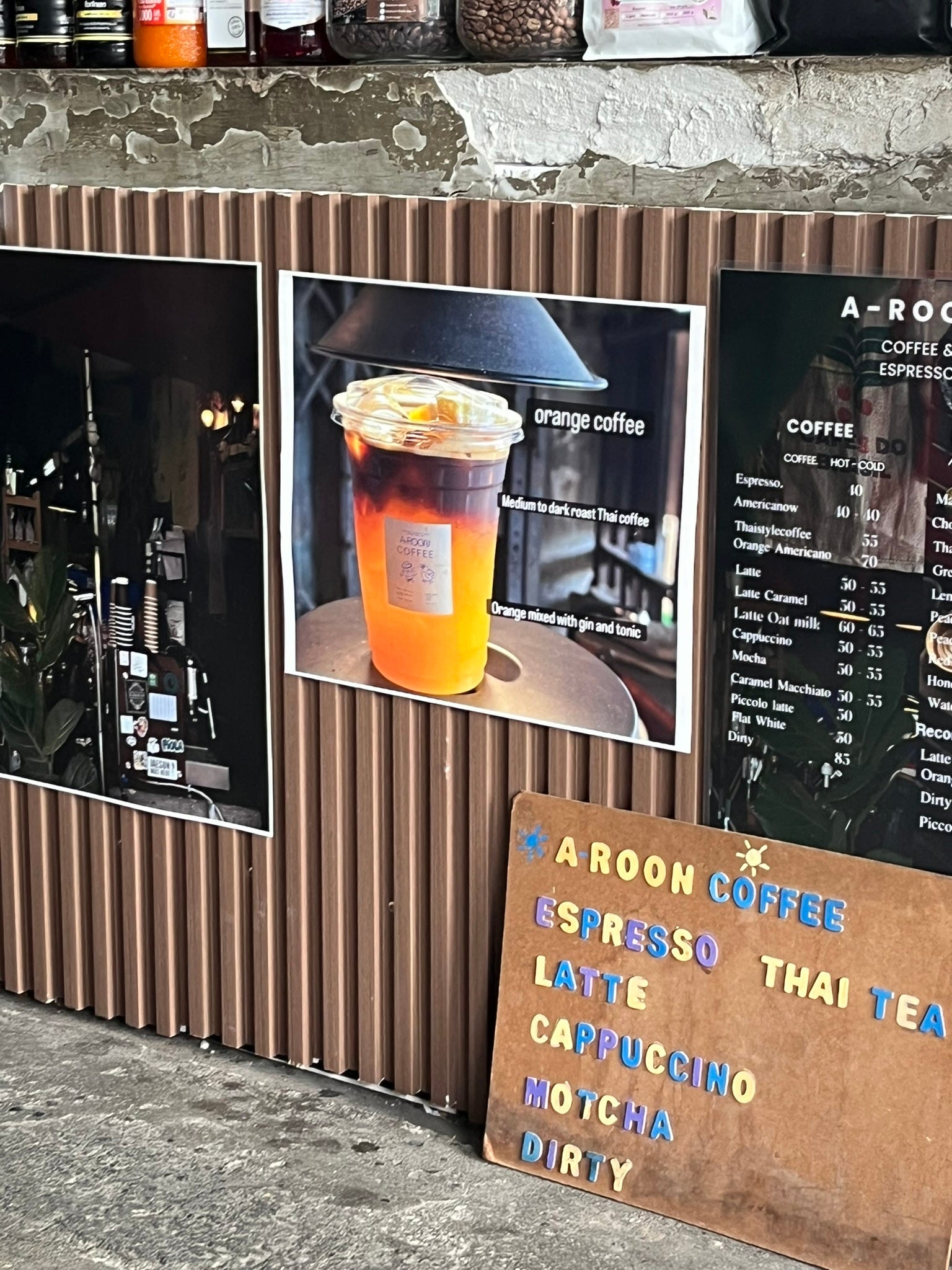
As appetizing as it sounds, we, of course, had to try it.
Within a sip, we were hooked.
As it turns out, Chiang Mai has become a coffee hub and the ‘orange espresso’ (primarily without gin) is a local signature. Over the course of a few days, we would come to try other espresso+ variants, ranging from more traditional espresso tonic to the more adventurous espresso passionfruit to finally discovering Mally’s favorite - the espresso coconut, an espresso poured over fresh coconut water, typically accompanied by said fresh coconut.
All of these coffees proved critical as most of the activities in Chiang Mai started in the early morning or stretched into the early hours of the next day.
Much like our South Africa journey, our time in Chiang Mai can be split between eating and drinking, hiking (to offset said drinking and eating), going out out, and trying to navigate the complex relationship between backpackers/ tourists and locals.
For ease of reading, we’ll stick with the chaptered approach, but for speed of delivery, it’s all one ‘book’ today.
Both the length and publishing delays can be blamed on Caleb’s continued propensity for verbosity and perfectionism. As a self-aware king, he apologizes in advance.
Chapter 1: Eating & Drinking (again)
Arriving on a Thursday, we had purposefully timed our visit so that we could go to the Friday, Saturday, and Sunday night markets - the biggest in Chiang Mai and some of the biggest in Thailand.
With a little bit more real estate than the sidewalks of Bangkok night markets, the Chiang Mai night markets took over full city streets from seemingly one side of the city’s walls to the other.
Walking through each market, stalls would alternate between handicrafts, Thai food, western food, pick your own sushi bars, head and foot massages (not right next to the food), designer-inspired clothing (Gucci bucket hats anyone?), t-shirts with bad English translations, made-in-China souvenirs, and art made in front of you to prove it wasn’t made in China.
With the largest turf, also comes the largest crowds, so we often found ourselves slowly shuffling, trapped in walls of people. To quell our growing agita of ‘why doesn’t anyone know how to walk’, we would pull over for snacks and Singhas.
We had fried chicken bites, coconut pancakes, freshly fried dumplings, spicy sausages on a stick, noodles, pad krapow moo, and rolled ice cream (a Caleb demand).


But the best meals weren’t consumed while wandering, those were instead found in the stalls just outside the market. The more robust the construction of signage, chairs, tables, tents, the more delicious the food (you don’t construct a full restaurant every day unless you get traffic).


The first all-star we were directed to was Khao Soi Khun Yai (thanks Nicole). Tucked in the parking lot of a temple, there were three women running a tight operation across broth duty, order management, and table management. Together they moved dozens of diners through their few tables – ensuring no seat was empty and no empty bowls lingered too long.
Over our few days, we sought out multiple khao soi establishments since it is one of our favorite things to order from Dannee Thai (our neighborhood go-to) and since Chiang Mai is where Caleb’s love of khao soi began ten years ago.
Traveling alone then, Caleb had befriended his hostel’s owner and was brought along for dinner where he was first introduced to khao soi. A mix of thick tomato, coconut, spiced broth, wet and hard noodles, onions, pickled veg, and usually chicken or pork – it is a comforting mainstay of Northern Thai cooking. He’s been searching for the high of his first bowl ever since and our stops proved to be a close competitors.


The second all-star, Cowboy Hat Lady, has had a cult following among backpackers since Anthony Bourdain’s Parts Unknown episode (and among Thais – likely since she set up shop).
While The Cowboy Hat Lady herself has retired, her daughter continues the delicious legacy of serving just one perfect dish - khao kha moo, slow-braised pork leg over rice.
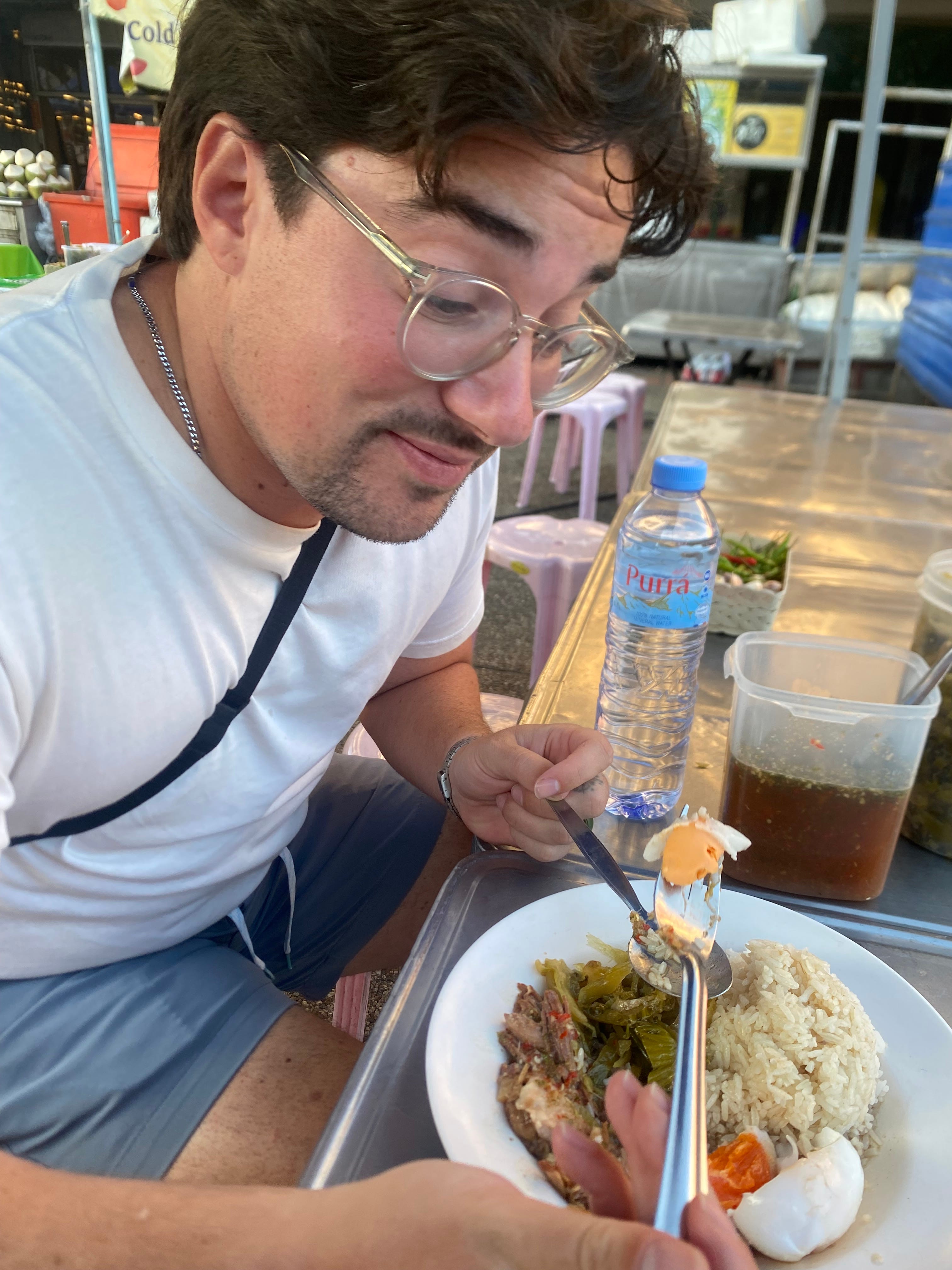
Our third seemingly unnamed all-star was a happy accident.
While waiting for an order of morning glory and more pad krapow at one establishment, we started to see a long line forming at one of its neighbors and people were waiting.
Order tickets were being furtively checked against the sole computer screen for updates.
Noting that a computer screen is a high-tech capital investment for a street stall, Caleb was sent over to inspect.
Crates of eggs piled taller than me, lettuce still being delivered by the cartful, and yet even more people joining the queue, I knew ‘now this is a spot’.
What is visiting Thailand, if not having two dinners back-to-back?
I put in an order.
Suffice to say, an hour (and one other meal later), our instincts paid off and our unknown pork-veg-egg-noodle soup was delicious.


The final all-star, though, was always just adjacent to the market. A respite with air conditioning, cold water, cold beer, hot and cold snacks, and a deep bench of unique and unheard-of chip flavors, you probably know her and maybe love her - none other than The 7-11.
Ubiquitously placed on nearly every corner in Thailand, 7-11 is so popular among locals and tourists that there are multiple guides to maximizing your 7-11 shopping – from beauty guides to herbal medicines to the best hot meals – we never found a 7-11 not busy.


And after a certain hour, the 7-11 is most busy with younger tourists lingering outside, chugging cheap Chang beers before they join the going out out ranks.
Skipping the 7-11 pre-game (because what are we? college students?), we opted for a jazz bar for our going out experience. Finding it packed to outside standing room only, we eventually had to pivot to a dive bar instead.
While the dive bar was meant to be a local spot, the only voices were English speaking. The beer was too cheap for many to pass up.
We sat down and were then quickly joined by two others – Hyeun from South Korea and Carlos from the Philippines. We exchanged stories of how we’d come to visit Chiang Mai, what we had seen so far, where the best food was, etc. Before Hyeun out of the blue proposed going to a gay bar.
Never one to turn down a party, we hopped in an Uber and made our way further out out.
Here we learned about the concept of SoBe – the ‘soul mate’ combination of soju (Korean rice alcohol) and beer – while watching and dancing to multiple drag shows.
Before we knew it, the bar was closing and it was time to part ways with our new friends.
We swapped instagrams and made a few story features, but it was one of those passing stranger nights where you know you likely won’t meet again and you enjoy the night that much more because of it.


Shockingly, we did not enjoy our next morning.
Waking up next to a half-consumed bucket of Kentucky Fried Chicken, our bodies and heads hurt in a way only SoBe could cause.
Unable to do much else with the day, we were lucky to benefit from the 13-hour time difference to FaceTime into The Girl’s ‘Goodbye Juj, Welcome to Our Big Living Room’ gathering. Despite the pounding headaches, it was a pretty special version of time travel to be feeling the after effects of the same day’s party while the party continued on hours behind us.
Chapter 2: Hiking
After wasting away our hangover day, we resolved that it was time to get up early again.
Besides, between dinners and nights going out out, we were quickly losing our skinny girl physiques from South Africa’s diet of Girl Dinners.
Thus, it was time to resume Caleb’s favorite activity– hiking.
Mally pulling out AllTrails, her new favorite app, found a couple of ‘moderate’ temple hikes that would take us from Chiang Mai University to the top of Doi Suthep, the mountain just East of the city, with stops at Wat Pha Lat and then Wat Phra That Doi Suthep along the way.
We were going to see wats (temples), learn about Buddhism, and exercise – arguably a great day.
Are we sure it’s moderate? Not like South Africa moderate? - Caleb
It’s called the Monks Walk, they do it all the time and they wear flip-flops. How hard can it be? - Mally
As Mally predicted, we made it to the first temple, Wat Pha Lat, rather seamlessly.
Caleb even acknowledged that the ‘hike’ had been more of a slightly inclined nature walk.
Ok, maybe you were right that it was truly ‘moderate’ – Caleb, an honest man
I am always right, so of course– Mally, fully herself
Walking around the temple grounds, we felt immediately at ease. The temple had a zen garden, multiple waterfalls and tributaries cutting through, and chedis (stupas) covered in thick moss.


Following other Lycra-clad visitors, we walked out the back of the temple into a somewhat cleared area of brush – supposedly our next path to the next temple.
At first, we were doing fine.
But unlike our initial hike, this second leg had the added perk of mid-morning sun and jungle humidity.
And then, we lost the path.
Looking around confused, with yet again not enough water, we didn’t really have any idea of where we should be walking. We waited a few minutes before spotting leopard print pants through the trees ahead of us. Trusting that this person knew the way, we quickly followed.
Following and following, the jungle brush, mud, and mini bouldering seemed to be getting more difficult, not less.
Catching our leopard-clad leader, we soon learned that she too was completely lost and was hoping we knew the way.
Well – this was a different leopard problem from South Africa.
Nervously laughing and becoming fast friends, we decided to just ‘maybe try this way?’
Getting steeper and steeper, it felt like we were using tree roots as ladder rungs to keep moving up the mountain.
And then, we heard mankind – motorbikes and semi-trucks just ahead of us.
Following the sound, we eventually reached a higher than you would think guard-rail.
Helping each other over, we were in the middle of the road, but back on a path.
Now able to locate the actual path on the AllTrails app (and finding helpful locals), we resumed our upward, muddy, sweaty trek.
Of course, on this last leg, while we were breathlessly heaving, we were lapped by several actual trail runners, who were completely unfazed by the thick slippery red mud or apparently the tendons in their knees and ankles (Inga – how do you do this ‘hobby’?).
Seeing a section of the trail labeled with the helpful graffiti of ‘angry pack of dogs!!’ and ‘no, seriously, dogs!!!’, we opted to finish out the last bit of the hike the safest way we knew – following the paved road.


Finally reaching the second temple, it was time first for yet another coconut espresso, before making our way to the golden chedis on high.
Taking off our shoes and wandering around the temple grounds, we watched the different versions of prayer and reflection. There were offerings of all types – flowers, candles, open bottles of water with a straw – people silently kneeling at the base of different Buddhas, and people silently circling the chedi for good luck.
We respectfully joined the line and circled the chedi clockwise several times for our own good fortune.


We kept exploring and soon learned the temple was built to honor a white elephant that carried a sacred Buddha relic up the mountain, trumpeted three times, and then died at the very spot where the temple now stands (Caleb feels this is particularly understandable after that hike).
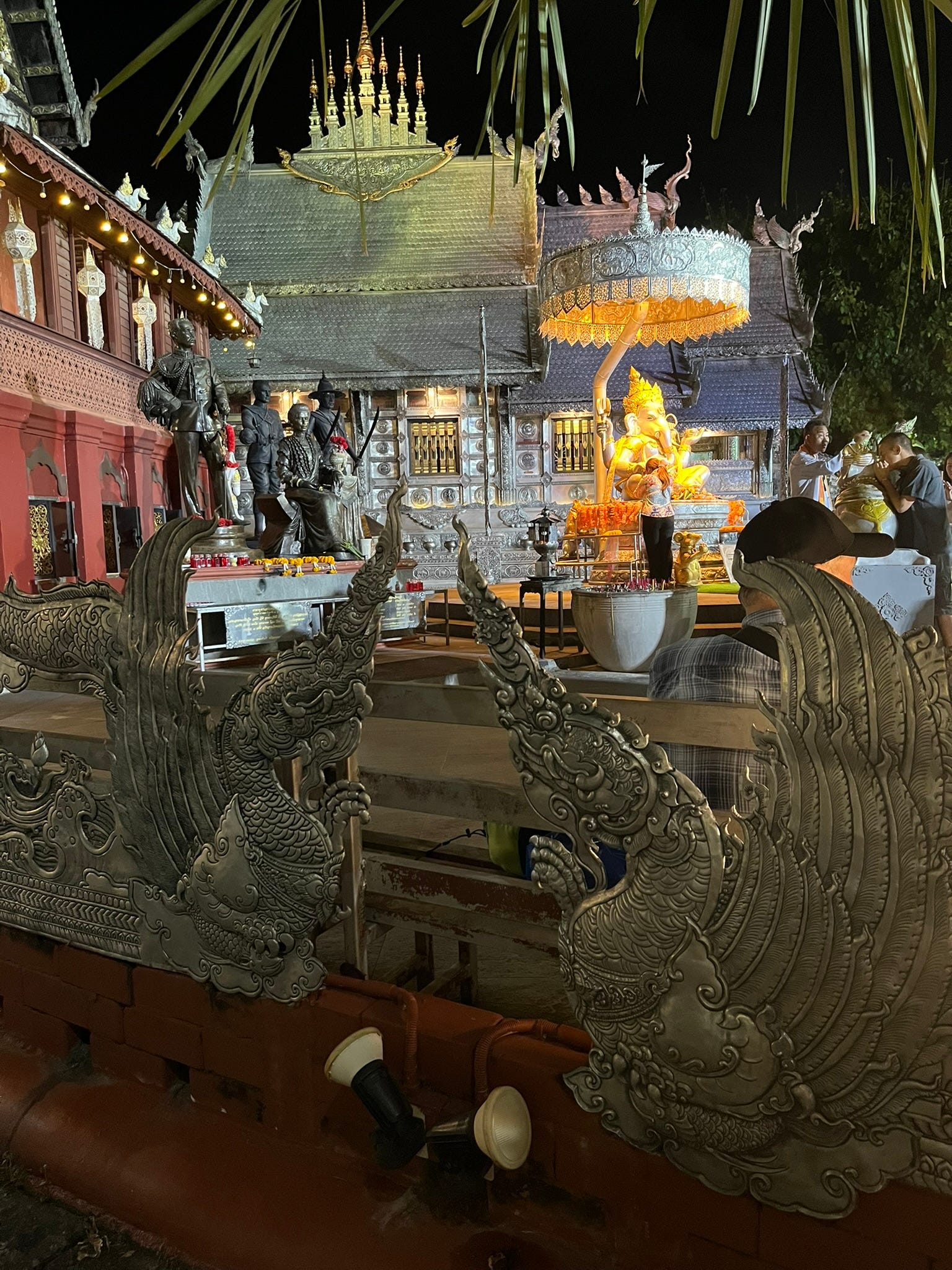
Another temple adventure came as a surprise night market interlude. As we were avoiding the crowds, we accidentally stumbled upon Wat Sri Suphan, colloquially referred to as the Silver Temple since it’s coated in plates of silver.
Weighing its entrance fee, we moved towards the side of the temple hoping we could get the gist from the outer wall. While peering over the side, we saw multiple people approach one of the temple’s statues, a rat, about 3 feet high. They bowed their heads and then moved closer to whisper into the rat’s ears.
Watching adults whispering secrets the way small children do when they first discover secret keeping felt profoundly human. We didn’t understand the significance of what the adults would be whispering or why they would whisper to the rat statue or what they’d hope to gain out of it. But seeing adults acting as innocent as children – just a purity of innocence – that we rarely see in our normal lives felt special. Like we too were part of the secret in that finding traditions that bring out the inner kid in us is something we need more of.
Chapter 3: Following the Music
Our last night in Chiang Mai, of course started with a night market, but 3 days into markets, we quickly hit our market limit and opted to peel off for a place to sit instead.
Walking down a side street, we heard music spilling out into the streets. We walked closer and asked if there was space.
There was a table right in the front.
We grabbed a few more Singhas and waited for the next band to come on.
Setting up, the band was a mix of personalities. The guitarist looked like he had walked out of the 1970s – long hair, mustache, bell bottomed jeans, a tan leather jacket, and a wide collared polo – he had his aesthetic. The bassist seemed like a caricature by comparison – clad in all black and silently hanging out off to the side. The next two guitarists were much more of this decade – one in skater boy uniform of plaid shirt, oversized jeans, and vans, the other in what seemed like a NYC inspired uniform – Yankees fitted (with a durag underneath), baggy jeans, an oversized plain t, and even had it down to Tims. Suffice to say it was a bit bizarre seeing a local Thai kid who in another life apparently was straight from the Bronx.
The depth of personality tore the house down.
Our Bronx friend shredded so hard he broke a string.
Our skater boy jumping around had a stage presence worthy of Madison Square Garden.
Our 1970s man carried every song.
And topping it all off, the host of the restaurant, sashayed around working the audience while turning tables to ensure each seat was full (and even caring for a drunk man asleep in his seat).
We stayed for the whole set. The next band and the next. Taking a quick break for dinner, we were asked to come back for the real show at 11pm. Past our bedtime, but we made it back. And stayed again until the bar closed.
There was something genuinely spontaneous about both of our nights out. We hadn’t made a plan. We certainly hadn’t planned to be out as late as we were. We couldn’t remember the last time we just went out out and followed where the night would take us. Was it college? Was it pre-covid work happy hours?
Something has changed in going out out since Covid. Mainly because we stopped doing it, but it also has become a bit more of a planning exercise – a ‘I kinda need a good reason to stay out past bed time’. The preference for eh I’d rather just put on comfy clothes and watch TV has won far more times than the ‘f it, let’s just see what happens’. And it feels like there’s a bit of a loss there. Like the city that never sleeps does sleep now. And maybe that’s just adulthood post-30, but I miss that spontaneity of talking to strangers, making them friends for the night, not knowing really how you ended up going from A to B, not because of alcohol, but because there wasn’t any overthinking or overoptimizing – it was just ‘hey what about this place’ ‘let’s do it’.
Chapter 4: The Banana Pancake Trail
One thing we consistently started to notice across our coffees, hikes, and nights out out in Chiang Mai was the overwhelming ratio of backpackers to locals.
On the days when we walked furthest out of the city center (including a one hour slog to the Coconut Market), the differences in storefronts were stark. Instead of coffee shops, there were kitchen supply stores. Instead of hostels, there were rows of houses. Instead of fancy cocktail bars, there were store-bar-restaurant combinations, one of which was supplying a whole soccer team.
The Old Walls of the city had a uniquely modern twist of keeping foreign backpackers in and clearly pushing the locals they were originally meant to defend out.
As we were walking around the city center, we also kept overhearing the same English conversations:
“Where are you going next?”
“Pai”
“Oh sickkk, I was just there… The beer is much cheaper there than here. We had a great time, and you should stay at XX hostel, they do XX shot special and they have a pool”
For anyone who has traveled SE Asia before, whether it was ten years ago or last summer, you’ve probably overheard variants of the same conversation too.
For those that haven’t yet traveled through the region, the reason these conversations are so prevalent is the Banana Pancake Trail, a well-trodden route between Thailand, Laos, Cambodia, Vietnam, and maybe a few countries further afield depending on the latest travel trends.
The Trail is meant to include a mix of cultural immersion, beautiful landscapes, adventure activities, and of course, cheap drinks and full-moon parties.


But the name Banana Pancake is meant to cheekily reference (or less generously, deride) the Westerner’s preference for palatable, non-spicy, simple and familiar forms of food, and thereby lack of cultural immersion.
There are hostels and hotels for all price points. There are coffee shops with fancy coffee and signs advertising Wi-Fi strong enough for digital nomads. There are menus in English with chilis indicating the spice level (often, over-estimates at that). There are Western toilets.
Having been to Chiang Mai ten years earlier though, it seemed that now these signs of tourism had fully tilted into overtourism.
While we enjoyed our multitude of espresso+ drinks, we didn’t want to be surrounded by English speaking tourists looking for their next party. We didn’t want to be part of the tourist-gentrification that was so evident in a literally walled city.
We had just left South Africa to get off the tourist trail and here we were a week later traveling on the SE Asian version.
So when it was time to look for our next stop, we knew it would be ‘anywhere but Pai’.
Flipping through our Lonely Planet (ironic, we know), we found Chiang Dao, a town that had only one paragraph vs three full pages.
We asked our hostel for directions to the right bus and felt validated when our host said, ‘Chiang Dao? Yes, good choice’.